Showing posts with label shoe review. Show all posts

Tuesday, February 10, 2015

Adidas Energy Boost 2 : A review


I always wanted to try the Boost series from Adidas ever since it was launched, and I finally get to try on the Adidas Energy Boost 2.

When I was in Hong Kong recently, I have noticed that Adidas has already fast replacing most of the models that are made from traditional EVA based midsole materials, and the newer models are constructed with the 'boost' material, also known as thermoplastic polyurethane (TPU) material found in the dashboards of BMW automobiles.  

This material looks like the foam used for the packaging, but the feel is totally different.  In fact they feel very springy and bouncy and I suppose that is the basis of greater energy return in the shoe design concept. And that is a bit of the technical background about the TPU material used in the all the Boost models.
Overall Structure: the shoe is built with a solid plastic like frame structure that wraps around the feet from the heel cup to the of the middle of the feet. In the middle the 3 stripes logo is also part of the cage like structure, offering a real snug fit that feels like an easily adjustable shoe lace.


The upper is also different from those traditional Adidas models; they are made of a stretchy mesh that feels like a pair of thick socks, but it is much thicker and is reinforced with a printed thin black structure that says Techfit.  The feeling is as though the shoes wrap around the feet like a pair of socks.


I found the upper to be exceptionally comfortable, but from the look of the mesh, I suspect that it will retain water which makes it not a very good shoe for the runners whom sweat a lot especially during a very long race such as marathon.  I will need to run in them during rainy days to confirm this.


For me, since this is the first pair of Boost I have ever tried on, my focus is always about the midsole of the shoe every time I wear them.

Overall, the foam is much softer than  the typical materials that are used in the midsole of most running shoes, and they gives the firm bouncy response every you feet land. The shoes are pretty good in terms of stability despite the heavy cushioning.


The Energy Boost 2 is a trainer, so it is slightly heavier due to the more TPU material packed in the midsole, but there are other lightweight models such as the Boston Boost etc.

The cushioning of these shoes are fantastic, and screams cushioning at the heels, so if you are a heel striker and you like good cushioning at the heels, these shoes are made for you.The forefoot area has less cushioning and that provides a firmer and more responsive feel during lift off.

Finally, in terms of the higher and heavier profile, thicker cushioning, I must say that the Adidas Energy Boost 2 will make a good training partner for the heavier runners whom prefer plenty of cushioning. For the rest, the shoes promise durability and much more comfortable ride for the longer runs.

Friday, May 30, 2014

Salomon X-Scream

A shoe built for the trail in the city.


Do you have a familiar trail within your city landscape that you always like to run in? And run starts from the road and through the staircase then across concrete pavement before reaching the gravel path and through the grass fields before entering the muddy foot path? If you do or if you like to run in such terrains, then it may be worthwhile that you checkout the new Salomon X-Scream.


The Salomon X-Scream falls into Salomon’s Citytrail category which which allows for an easy transition from door to trail. and it is really a hybrid shoe that is designed for the urban landscape.

The Salomon X-Scream offers good dynamic cushioning, versatility and durability as key features making it a shoe suitable to run in mixed terrains found in the city landscape such as concrete, rocks, asphalt, grass, or even foot tracks that are made of packed sand or gravels.


One of the key concept behind the X-Scream is to provide good surface adaptation, which means it is able to provide excellent transition between different terrains.

The sole is constructed with the OS Tendon system acts like a real tendon by flexing to provide stretch and balance during the heel-to-toe transition. The Salomon X-Scream is also constructed with the Contagrip outsole of differing densities which explains the fantastic traction over different terrains.


The X-Scream also offers excellent cushioning and support, through the Lightweight Muscle material and injected EVA midsole, which provides dynamic cushioning and thus it is found to be very comfortable and springy without that bulky feeling.


The Sensiflex; which is a fabric that allows the foot to expand in a controlled manner increasing foothold is built into the X-Scream at just the right spot of the upper is there to provide a good combination of freedom and foot hold.


And with no exception, just like many of the Salomon running shoes, the design also includes the concept of Adaptive Fit which wraps the foot with a precise and secure Quick-Lace system as found in most of the Salomon shoes.


The X-Scream incorporates many features and ideas from challenges found in trail running into the daily running activities in the urban environment. The best is the flexibility of the door to trail concept which allows the shoe to be run in any kind of terrain.

Ready to explore the trail within the city with the X-Scream?


Tuesday, April 29, 2014

Skechers GOMeb Speed 2


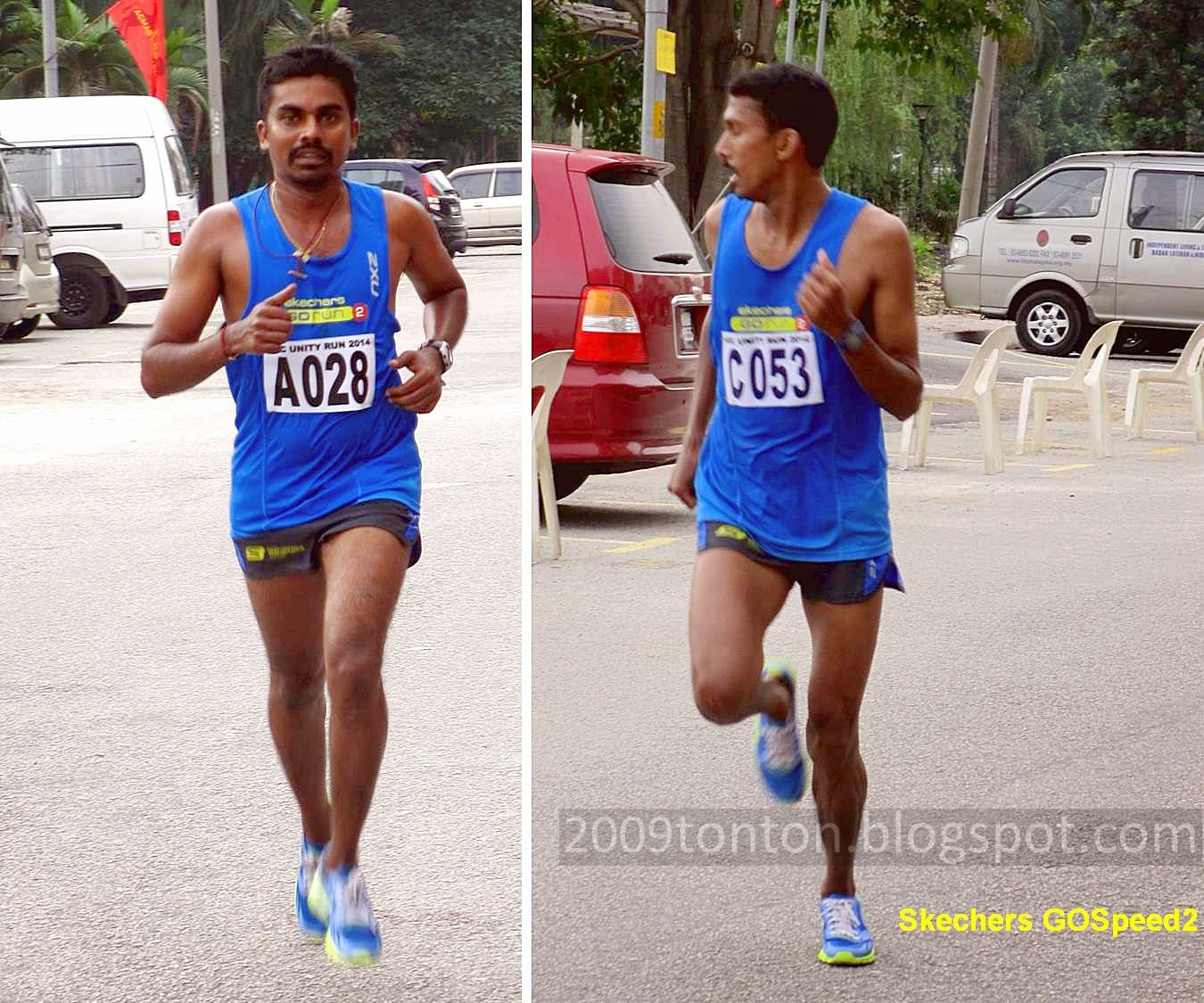
The Skechers GOMeb Speed has always been one of my favorite racing ride since they were introduced last year and I have really grown to love these lightweight racers especially in my 10k races. They perform so well as racing flats with the low profile, light weight and firm midsole, that I have worn off 2 pairs just within last year alone (covering about 1100 kms) for both racing and speed training.  So it really exciting when I get to try the replacement, i.e. GOMeb Speed 2 from Skechers.


A quick comparison between the first and second generation of GOMeb Speed shows that the Speed 2 does not feature the loud bright contrast colors as it's predecessor, but you won't missed recognizing the Speed 2 that stands out as a pair of very fast looking racing flats at the Skechers shop.


Without looking at the technical literature of the Speed 2, I feels that there are no changes made in the midsole; both the GOMeb Speed and Speed 2 has the same mid-sole in terms of physical design and material. They both have the same feel when you run in them, very firm landing with sufficient support yet very responsive during lift off, a feature that all fast shoes should have.  And the stability plate is still there, which I believes is one of the reason why these shoes are so responsive.


But there are major updates and changes made to the materials used for the shoe's upper and tongue. These changes for me seems to be a very appropriate, they are well engineered with simplified design, and minimal but yet improvement is significant.  The Speed 2 upper is made of a different material; some kind of synthetic fabric that is non-elastic and thin of which I suspect contributes to the 'light weight' of these shoes.


Even the construction is different as it is seamless with the supporting structure imprinted onto the upper instead of being sew on, so there is very minimal stitching found in the upper of the shoes. This is good news for sock-less runners because seam less also means less chaffing.

I find that the material used in Speed 2 does not retain moisture and in fact they dry up pretty quickly; another plus point which means it will stay lightweight throughout during longer races such as a full and half marathon.


In terms of fit and comfort, the thinner upper with the ventilating pores seems to make these shoes give a cooling feel, and this is definitely a plus for fast runners in hotter climate like us. Both generations of Speed are designed based for racing so they offer the typical snug fit feel just like most racing shoes, and therefore you might want to try properly when you chose you sizing.


During the recent races I had a good chat with the members of Team Skechers Malaysia about the Speed 2 and we all agreed that these shoes were great performers especially the weight of the shoes.


There are a few colors to choose from but seems like blue is popular.


Unless you got yourself a pair of limited edition like bro Murali here which is in black and gold.


So far I really enjoyed racing in them plus they have so delivered great results in most of the races.


And the ladies version of the GOMeb Speed 2 are really gorgeous with the metallic color theme. Overall, without being too technical, I must say that the GOMeb Speed2 is a must to try if you are looking for a pair of snug fitting, light weight, responsive racing flats.

Thursday, December 12, 2013

Skechers Nite Owl : Shoe Review


It has been raining lately and because of the crazy weather, most of us have to adjust ourselves to run at irregular hours, and especially those who are working will have to run in the dark most of the time. And it is just timely when Skechers has release the Nite Owl series, a shoe that glows in the dark for the winter months. The concept is simple, by providing safety to runners through better visibility.


All you need to do is to put it under the sun or any light sources for at least 15 minutes and it will glow for a few hours! Being kiasu, we put ours under the sun for an hour.


After charging, like small children we tried checking out the glow effect by putting the shoes at various dark places...and we begin to notice the effect even though it is quite bright.

And then this is what they looked like inside the shoe-rack.


Under the late afternoon sun, you can't notice the glowing material, so it is just your typical Skechers GORun 2.


But as the sun begin to set, the glowing starts to get visible.


It really does feel safer when you know that you are visible to the rest of the traffic, especially when there are minimal street lighting available.


As it got darker, so the glowing became very obvious, and we felt like some kind of Star Wars characters.
The Nite Owl models shown here are the Skechers GOrun 2.

The GOrun 2 is basically a trainer that is designed for speed; with innovative performance technologies to promote a midfoot strike therefore works as a great transitional shoe to foster a barefoot running experience. You can check out our review of the GORun 2 here.  For us they are really suitable to be use as everyday trainers.

Here, the one with the black upper base is the male version.

We understand that the glow comes from Photoluminescent Technology. It utilizes Phosphorus, which is used in glow in the dark products. (I think they are like those material that are used to make little stars that you stick on the wall of little children room that will glow when you turn of the light, except that this one last very much longer with minimal charging time).

The technology is applied into a few specific parts on the uppers of the shoes. These 'treated' area basically absorbs light and then re-emit it slowly. Another thing we notice is that the Photoluminescent treatment is permanent therefore it cannot be remove easily.

The best way to “charge” the shoes is in direct sunlight but any other light source (even artificial ones) will be fine.  A 15 minutes or so will provide a full charge. The shoes will shine for a few hours and then it will slowly fade after that.


Tuesday, November 26, 2013

Puma Bioweb Elite: A Shoe Review


The Bioweb Elite is another distinguished looking running shoe from PUMA that incorporates a unique design.  This shoe has a single piece spider web-like upper, where this design concept will provide a 'wrapping' feel on the foot.


I have been running on the PUMA BioWeb Elite on and off for about 2 months now, and I used them mostly on easy days. I find them to be excellent as a pair of trainer when I do my longer runs or when I incorporate some cross training during my runs.


Compare to the PUMA Faas series which emphasizes neutrality, lightweight cushioning and flexibility, the BioWeb is basically a much more firm, and structured shoe. If you take a closer look at these shoes, it screams stability all over.


When I first saw the Bioweb Elite, I thought these shoes will be as cushy as the Puma Faas 500 because both of these shoes looks as if though they are packed with the same amount amount of cushioning materials at the outsole.

But as I ran in them, I found that despite the high profile of the sole and the volume of cushioning, the cushions are very firm and stable, therefore provide excellent responsiveness.


 The shoe absorb the impacts of every landing that I made very well and so lift off was easy.


Another comparison one might one to make is the flexibility especially during transition. It seems that although the outsole is not as flexible as the Faas, but the Bioweb Elite is somewhat flexible at the forefoot area, thus allow the shoe to provide a smooth transition at toe off.


I made some research on the technical aspect on the design of the shoe, and found that the concept behind the design is very much based on the principles of the structure of the spider web; with the upper consists of mesh wrapped in a web-like structure, and this part is called the WebCage. This design in the upper provides a comfortable fitting. I find this is quite true even for a sock-less runner like me.


And due to the web cage structure, the shoe upper is firm and is not stretchy, and I supposed the spider web layout at the upper has been designed in such so to provide that a cover that wrap around the feet from heel to toe in a very structured manner, yet without restricting the feet movement while running. As such I think this will bring happiness to those runners who prefer snug fitting uppers.


There is also a 'Glow' variant of the Bioweb Elite which incorporates glowing material at the bottom of the sole as well as at the upper to provide better visibility in the dark.


From a personal perspective, I find the Bioweb Elite is an excellent choice if you are looking for a multipurpose or versatile shoe for cross training eg. a pair of trainers that allow you to do your gym/weight workouts besides running.  Also worth checking this shoe out if you are into activities such as boot camps like training but this is definitely a good multipurpose trainer. 

Tuesday, July 9, 2013

Puma Faas 500 v2 - Review

This is the Puma Faas 500 v2. I really like to start by saying that I really like the name 'Faas', well, it sounds fast with a Jamaican slang.

And the number 500 v2 denotes the "Faasfoam" cushioning level 500. The Puma Faas running shoes family from Puma basically comes with a range of cushioning level ranging from 200 (minimal)  to 1000 (cushioned). That means if you prefer a lighter, more minimal ride, then you should select a Faas that has a lower FaasFoam cushioning number. And same thing for a plush, more cushioned ride, you should opt for a higher FaasFoam cushioning number and so on. (more information about Faasfoam at the bottom of this post)


Anyway, in our everyday languange, the Puma Faas 500 v2 is a really a neutral trainer that has been fitted with optimized amount of FaasFoam cushioning and underfoot protection, suitable for everyday training. When I tried the shoe the first thing that I noticed is that they are surprisingly very much lighter than they looked.


Technically, the number 500 v2 means this is version 2, and for those whom had tried the original 500, the difference is, with this updated version the shoe brings the heel to toe ratio down to 4mm. It also comes with a new midfoot lockdown (a minimal combination of synthetic and breathable air mesh) which is designed to helps keep the foot stable throughout your gait cycle.


Although the Puma Faas 500 v2 is a neutral shoe (there isn't to much control structure built within the shoe) and has a very low profile, it is not a minimalist shoe. The shoe is very well cushioned - I can feel that the cushion works in a absorbing feel instead of being bouncy and for that I really think it is an excellent trainer for most runners-any softer it would be not as responsive and if any firmer, then it might not be as comfortable especially for longer runs. Runners whom prefer a much neutral based running shoes will definitely appreciate the 4mm heel-to-toe drop and the light weight characteristics.


The soft outsole also delivery very good grip on the road. I learned that it is a combination of blown rubber also contributed for the extra cushioning, and is also designed with high abrasion resistant rubber.


The uppers are made from very breathable mesh and the color scheme is very attractive too. This is important for our warm climate and the reflective striking colors promises that you are visible to other traffic users all the time.


Inside, the sock liner is surprisingly smooth and for I find them comfortable running with them without socks.


In terms of fitting, I find the shoes offers snug fit feeling at the mid foot area and in the toe box area, there are  ample room that I can wiggle my toes about.


The Puma Faas 500 v2 is an excellent choice as a comfortable everyday trainer. Those who clock heavy mileage will find the shoes fits in perfectly for those easy days.  The extra cushioning level given by the Faasfoam 500 might work well for runners (perhaps heavier runners?) who prefers a combo of neutral running and cushion.

Besides the 500, the Faas offers a wide range of cushioning level to choose from. You can check out the cushioning scale for the entire range at the Puma Faas website. The FaasFoam Cushioning Scale helps you select the ideal shoe for you.


Related Posts Plugin for WordPress, Blogger...